
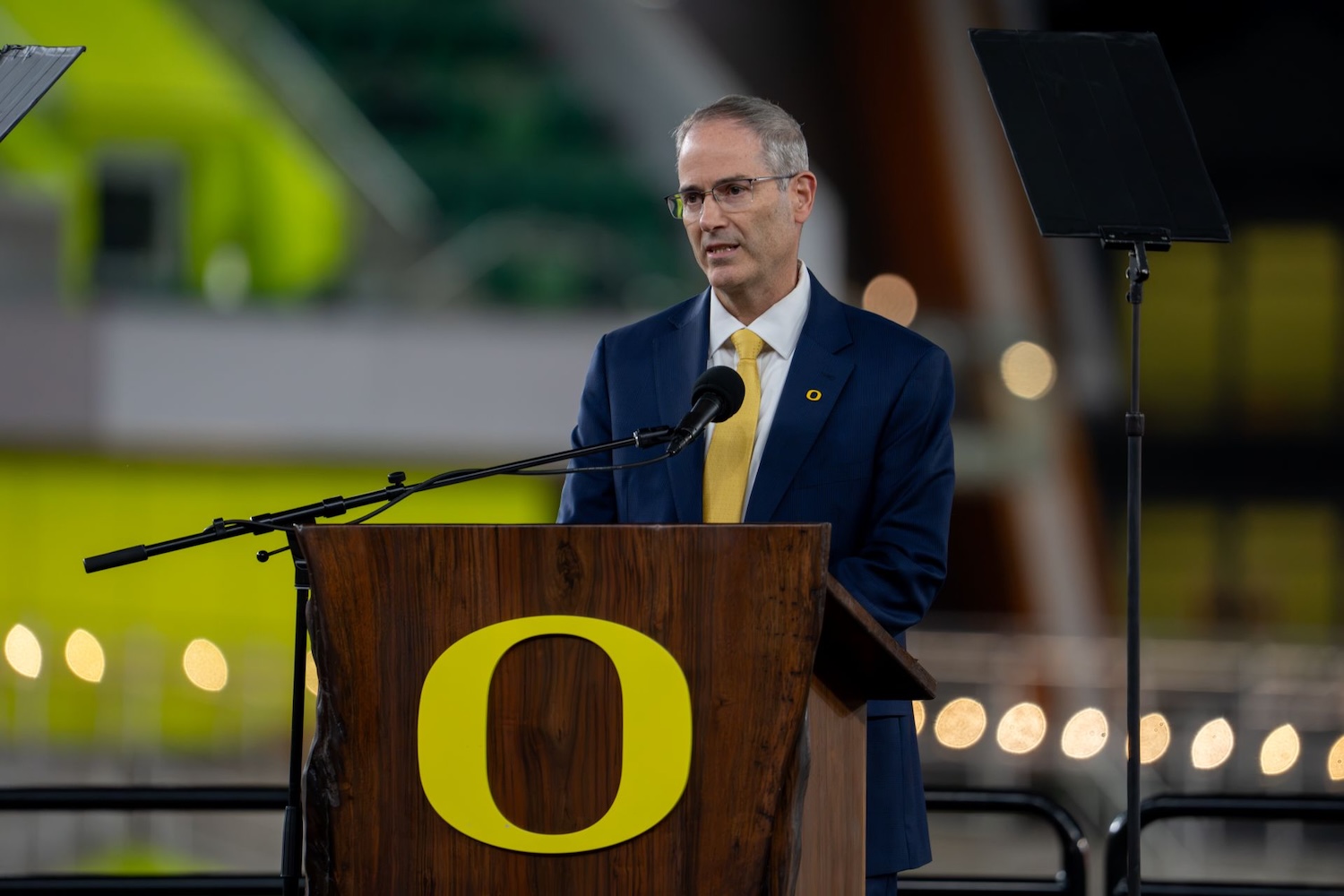
This year we celebrate the 150th anniversary of the University of Oregon. In welcoming the Class of 2030 at convocation on September 27, 2026, I emphasized the enduring purpose of an Oregon education:
The opening day of the University of Oregon was quiet and unassuming.
There were no speeches, no fanfare, just the solemn calling together of students who began their schooling on the first floor of an unfinished building, surrounded by farmland.
Tonight, 150 years later, we join generations of students and faculty who have answered the call of an abiding and common purpose: to concern ourselves with the deepest questions of the human condition, to discern the contours of a meaningful life, and to turn attention to the complex, interconnected world we inhabit.
Long before universities existed, there was scholé, the Greek word from which we derive “scholar” and “school” that names the free time one needs to concern oneself with truth, the truth the world expresses, and the truth discerned within oneself.
These two orientations, outward to the world and inward to the mind, give shape to the research and educational mission to which, a hundred and fifty years ago, the University of Oregon was consecrated, and to which we rededicate ourselves here today.
The university is a sacred place. I don’t mean this in a religious sense, but in a sense that harkens back to the word’s Latin origin, sacrare, which means “to set apart” and “to dedicate.”
The university is a place set apart and dedicated to the search for truth. Here, students and faculty are free to ask bold questions, to challenge assumptions, and to attend to and nurture ideas that unsettle the status quo. That freedom matters for scholarship…and for our democracy. A healthy society depends on citizens who think critically, who are creative and imaginative, and who are willing to pursue truth wherever it leads.
This is no easy task. Higher education today faces scrutiny and pressure from many directions. Powerful forces seek to censor and constrict the deepest purpose of the university. Public trust has weakened. Funding models are straining. New technologies are flattening the texture of human thought and language, dulling curiosity, and robbing us of our capacity to imagine and co-create a future worth wanting.
Yet the university has weathered many mighty storms before, and it has always endured, because each generation has found new ways to carry forward its ancient purpose.
To our new students here today: You stand at the beginning of an adventure of thought and discovery. The four years of schooling spread out before you offer a very special kind of time, set-apart and dedicated, to explore the ideas that will shape you and to discern who you are and who you might yet become.
The University of Oregon offers you an apprenticeship in discernment; an embodied practice that disciplines attention, refines understanding, and cultivates judgement. A machine can sort, rank, and calculate much faster than we can. Only a human being can draw on lived experience to imagine and create a better future.
Mens agitat molem, the very motto of the University of Oregon, gives voice to this idea that the discerning mind matters; that the liberal arts and sciences are necessities, not luxuries, in any society that means to govern itself; that freedom of thought is the daily habit of our collective flourishing; and that ideas, tested and challenged in open exchange, are the beating heart of a vibrant democracy.
As we celebrate this milestone tonight, let us reaffirm our commitment to the solemn work of free inquiry, alive to the unresolved mysteries of experience and responsive to a world so badly in need of the wisdom we seek.
One hundred and fifty years ago, in a half-built hall, this university quietly began enrolling students.
Then, as now, the work remains unfinished.
Then, as now, the promise of this place endures, undiminished.